
Let me share a secret with you…
3 Aug 2026As emerging design professionals, many architectural graduates look toward residential skyscrapers, cultural hubs, or community pavilions to make their mark. Data centres rarely cross their minds, let alone their drawing boards. We are taught to design for human scale, light, and unity. So, how do we pivot to designing for servers &, cooling stacks?
Architecture and the Creation of Community Spaces
11 May 2026Community-oriented architecture is fundamentally about people. It focuses on creating spaces that invite interaction, encourage movement, and make people feel welcome, safe, and able to connect. In urban environments, the streets, parks, and civic spaces that stitch a city together rely heavily on design to shape how people experience and inhabit them. Well-designed public spaces support casual encounters, create opportunities for shared experiences, and spontaneous interactions.
Seeing Data Centres for the First Time
30 Mar 2026The first time I saw a Data Centre I wasn’t quite sure what to expect. I assumed these buildings would be functional, robust, understated and unapologetically driven by performance rather than a strong architectural identity. My initial impression was that these buildings were driven by engineering requirements, with architecture acting as the framework that enables their performance.
Iberia’s Digital Future Unlocked By Strategic Growth
19 Feb 2026Portugal and Spain are increasingly prominent destinations for data centre investment. As capacity tightens in established Tier 1 European markets, international operators are widening their search for power, land and connectivity and Iberia is benefitting from that shift.
The Architect’s Role in Reducing Embodied Carbon in Data Centres
19 Dec 2025With the expansion of the digital economy, data centres have emerged as essential infrastructure, but they are still some of the most carbon-intensive types of buildings.
Introducing studioNWA Learning Hub!
8 Dec 2025studioNWA Learning Hub gives our team dedicated time and space to share questions, and talk through challenges. It’s open to anyone in the practice who wants to learn more, join the conversation or simply listen in.
Turning Data into Art: studioNWA Brings London’s Voices to Life on a Six-Storey Façade
8 Dec 2025The studioNWA team is proud to have helped bring the complex six-storey façade of this new data centre to life.
3rd Data Centre Design Engineering and Construction Summit 2025
4 Dec 2025Jonathon Stockdale, Director at studioNWA, attended the 3rd Data Centre Design Engineering and Construction Summit, on the 2nd and 3rd of December.
London Build Expo 2025
3 Dec 2025Alex Soto, Associate Director and Head of Sustainability, and Leticia Gonzalez-Arenal MCIAT, Chartered Senior Architectural Technologist at studioNWA, attended London Build Expo 2025.
Construção de Data Centers 2025
1 Dec 2025This week, our team, represented by Laura Deus and Pedro Moura, attended the “Construção de Data Centers” event, organized by Grupo Vía in Lisbon.
Social Media


studioNWA is committed to a carbon management plan to reduce operational carbon emissions, in line with the UK and global Net Zero target by 2050 to limit the effects of climate change.
The framework:
- We identify operational carbon emissions categories based on the Greenhouse Gas (GHG) Protocol Corporate Standard for accounting and reporting scopes 1, 2 and 3 emissions.
- We quantify and record emissions in the studioNWA database supported by UK Government GHG Conversion Factors for Company Reporting data.
- We monitor emissions on a yearly basis and benchmark against 2019, our baseline year.
- We set goals and implement actions to reduce scope 1, 2 and 3 emissions in percentage increments each year.
- We inform staff and stakeholders on a summary of actions and progress in a Sustainability Report presented at the end of Q4 each year.
Scopes 1,2 & 3
36.7 Tonnes CO2e

Embodied carbon represents the accumulative emissions a particular material or product generates throughout its lifetime, from manufacturing stage to installation during construction, maintenance and disposal at its end of life.
Classified as critical infrastructure buildings, data centres are required to meet high levels of security, performance and insurance conditions, thus having to rely on traditional high performing, durable materials such as concrete, steel and aluminium – amongst the highest in embodied carbon content.
As material specifiers, we engage with stakeholders in the supply chain to stay up to date with advances to manufacturing processes of traditional materials and to encourage a growing portfolio of lower carbon alternatives. We analyse embodied carbon data from EPD certificates and prioritise reduced upfront carbon (A1-A5) and circularity whenever possible.
studioNWA has also developed ECMat, its own carbon management tool to produce project case studies and to benchmark embodied carbon of materials as we continue to improve our carbon-conscious spec.
Measure. Monitor progress. Push for change. That’s studioNWA‘s approach to advancing Net Zero.
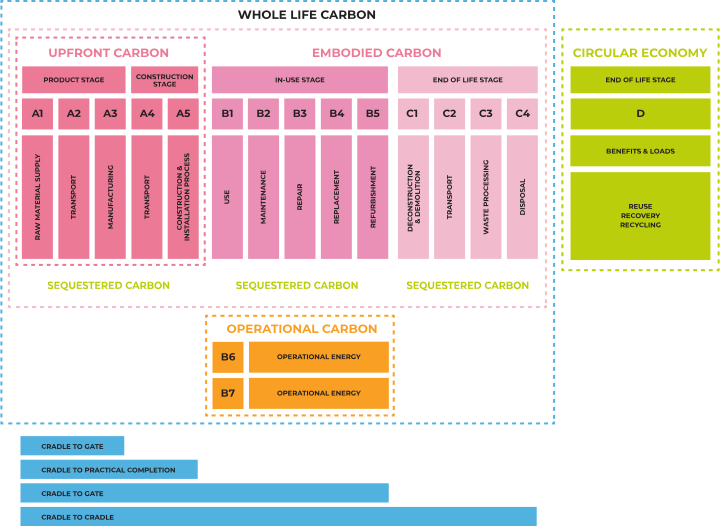
Life Cycle Assessment Stages: BS EN 15978:2011
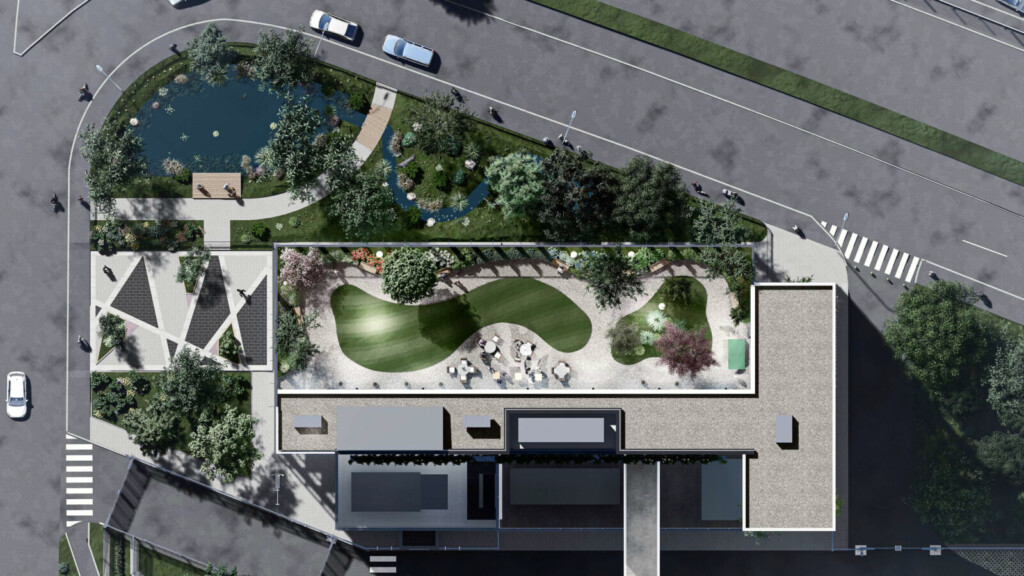
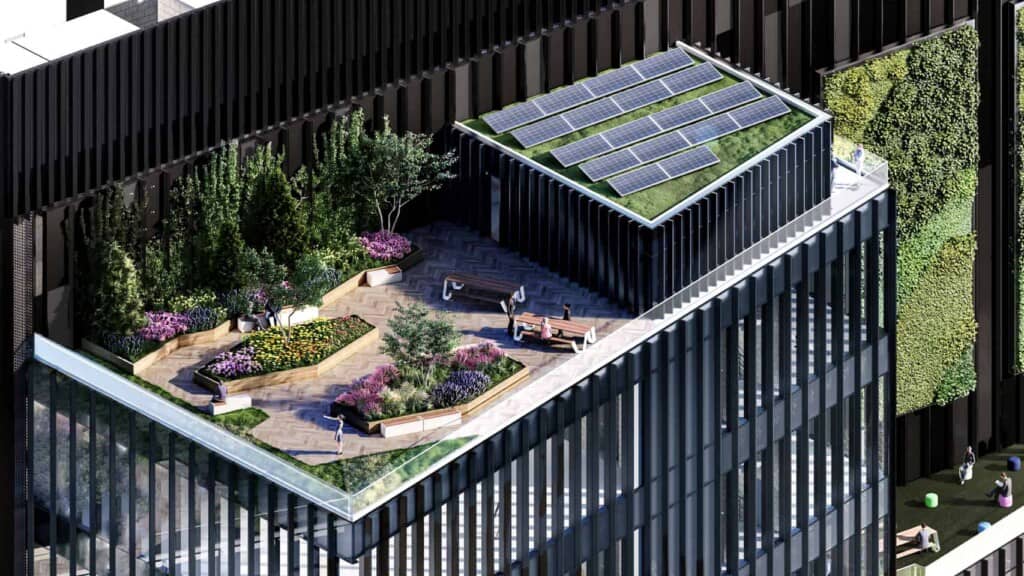
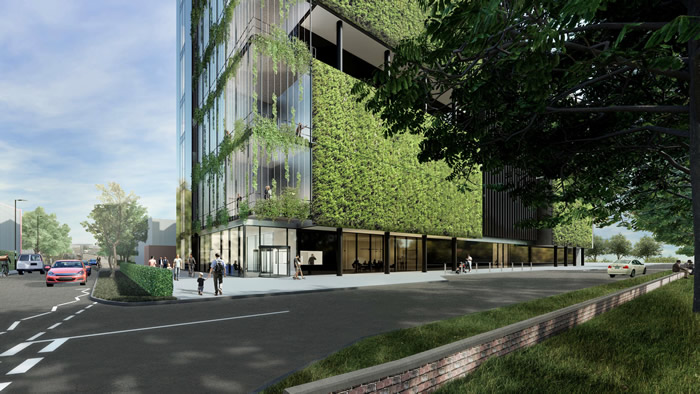
Urban greening has become more prevalent as a planning requirement in urban settings, where contributions can be made in the form of green roofs, green walls and amenity areas.
studioNWA engages with Local Planning authorities and specialists to identify the best solution for a given project site to mitigate heat island effect, air pollution, rainwater storm management and
contribute to on-site carbon capture, whilst meeting relevant policy targets.
BREEAM & LEED assessments are the leading and most widely adopted environmental assessment methods for data centre buildings today, often pursued at planning stage and to reinforce client’s ESG goals.
studioNWA’s in-house knowledge of these certification schemes allows us to work closely with our clients, sustainability consultants and wider design team to maximise the potential for architecturally-driven credits and meet project targets.

Water
- Selection of plumbing fixtures that reduce water consumption.
- Rainwater harvesting space allocation.

Materials
- Use of materials with high Green Guide Ratings to ensure lower environmental impact.
- Responsible sourcing of wood with sustainability accreditations

Waste
- Adequate provision of recyclable waste storage facilities to ensure waste generated during building operation is diverted from landfill.

Pollution
- Screened mechanical plant areas for noise attenuation.

Land use and energy
Implementation of green roof and walls for a number of benefits:
- Contribution to greening factor, stormwater attenuation, filtration of air pollutants and carbon sequestration, reduction of heat island effect and thermal losses.

Transport
- Provision of bicycle shelters and changing facilities to encourage building users to cycle to site, thus reducing carbon emissions from transport.
- Charging stations for electrical vehicles.

Health and Wellbeing
- Design to provide building occupants with adequate levels of natural daylighting, views out and glare control.
- Indoor air quality to be protected from external sources of pollution such as exhausts and cigarette smoke.
- Selection of interior finishes with regulated off-gassing emissions.
“Fabric first” approach optimises thermal performance of the building envelope to reduce energy use demands from the outset of the design process.
In data centre typologies, this methodology is particularly effective for the design of administration blocks, as daylighting and views out are an inherent requirement for office areas with permanent workstations, meeting rooms and amenity spaces.
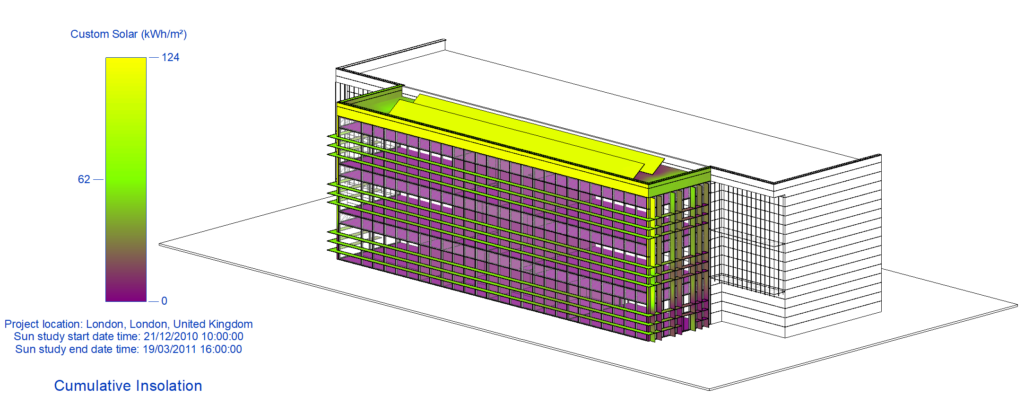 Glazing ratios and solar shading devices designed to suit solar orientation ensure the building façade becomes more resilient to excessive heat gains and losses.
In addition, the optimisation of U-values in external walls, roofs and floors, and effective airtightness details result in a thermally efficient building envelope that reduces Energy Use Intensity (EUI) per square metre and associated carbon emissions.
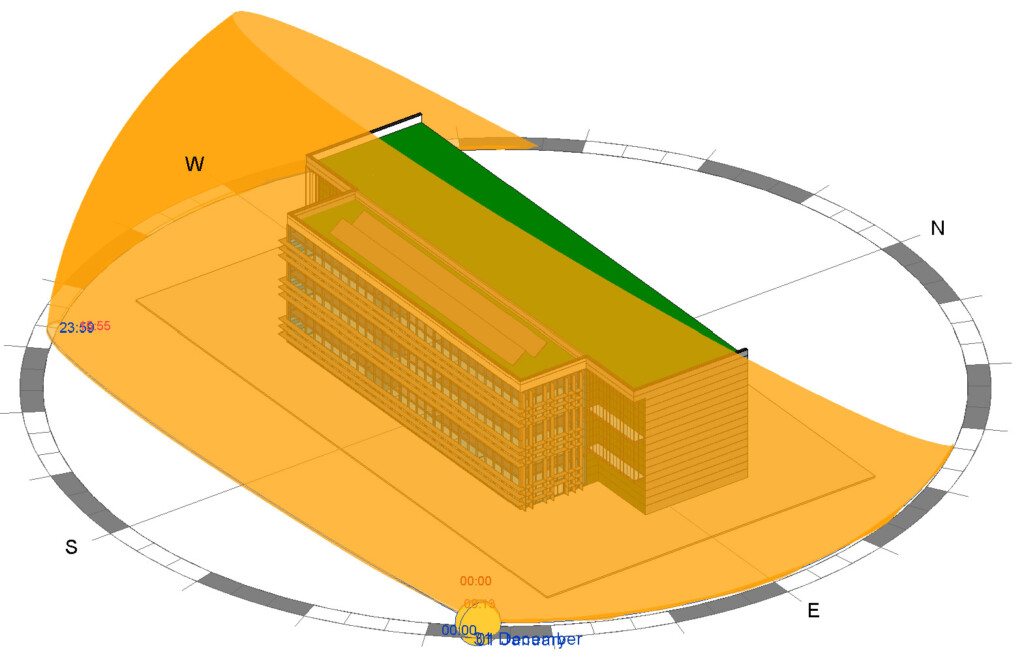
studioNWA continues to invest in its own sustainability capabilities, including software that can provide real-time design feedback on elements that affect thermal performance of the building fabric. Our design toolkit can also assist the team to identify optimal areas for the installation of solar panels, based on incident solar irradiation values on horizontal and vertical planes.
studioNWA’s early stage design approach facilitates coordination with other disciplines and alignment of energy model targets, contributing to reduction of energy consumption and associated carbon emissions.